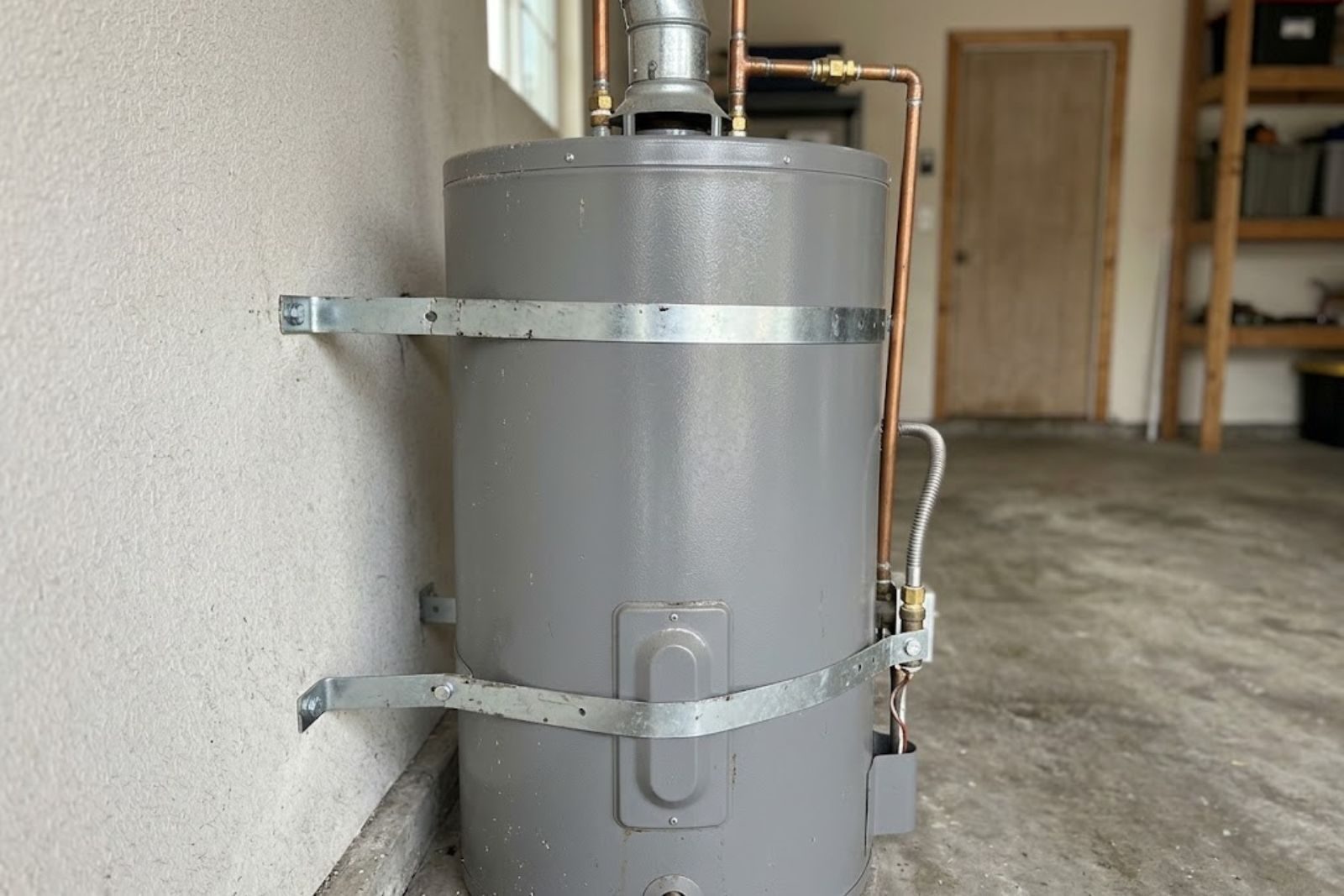
Most Walnut, CA homeowners have never actually looked at their water heater's strapping, even though California law has required it for decades. It's the kind of detail that's easy to overlook because an unstrapped water heater doesn't cause any problem at all until the specific moment it matters most: during an earthquake, when a rigid gas connection and a top-heavy tank are a genuinely dangerous combination.
What the Law Actually Requires
California Health & Safety Code Section 19211 requires that water heaters be braced, anchored, or strapped to resist falling or horizontal displacement during an earthquake. The technical specification comes from the California Plumbing Code: two strapping points, one within the upper third of the tank and one within the lower third. The lower strap must sit at least 4 inches above the thermostat and gas control valve, so it can't interfere with or damage those components.
This applies to every residential water heater in California, not just new installations. If your home has an older water heater that predates a more recent code update, or if a previous owner or contractor didn't secure it properly, it's out of compliance regardless of when the code was adopted. The requirement doesn't grandfather in older installations the way some other code provisions do.
Why This Specific Failure Mode Matters
A water heater is unusually well-positioned to cause secondary damage during an earthquake because of what's connected to it. It's tall and top-heavy, connected to a rigid gas line, and often sits near electrical connections and a pilot light or ignition source. During lateral ground movement, an unstrapped unit can rock, slide, or tip over entirely. When that happens, the rigid gas connection can shear or crack, creating a gas leak in immediate proximity to whatever ignition source the appliance itself provides.
This is one of the more common causes of a post-earthquake residential fire, and it's specifically why the requirement targets this appliance rather than treating all heavy furniture or appliances the same way. A toppled bookshelf is a hazard; a toppled, leaking, potentially ignited water heater is a different category of risk entirely.
How to Check Your Own Water Heater
You can do a basic visual check yourself before deciding whether to call someone:
- Look for two separate metal straps wrapping around the tank, one near the top and one near the bottom third of the unit.
- Confirm both straps are anchored into solid wall framing or a masonry anchor, not just resting against drywall with no real structural attachment.
- Check that the lower strap sits at least a few inches above the gas control valve and thermostat, not directly over either component.
- Give the tank a gentle push near the top; it shouldn't rock or shift noticeably if the strapping is properly tensioned.
If you see only one strap, straps that appear loose or improperly tensioned, or no strapping at all, that's worth addressing before it becomes relevant during an actual seismic event rather than after.
What's Involved in Fixing It
Adding or correcting seismic strapping is a relatively small job on its own, and most plumbers can address it during a standard water heater service visit rather than requiring a separate appointment. The straps themselves anchor into wall studs or, where studs aren't accessible in the right position, into blocking installed between studs or a concrete/masonry anchor rated for the load.
If you're already having other water heater work done, mentioning strapping during that visit is efficient, since a technician working on the unit can check and correct it at the same time without additional scheduling. If your water heater is otherwise functioning fine and strapping is the only concern, it's still worth addressing on its own rather than waiting for an unrelated service call.
A Note on Rental Properties and HOAs
Landlords and property managers carry a particular responsibility here, since a tenant may not know to check their unit's strapping and typically doesn't have the authority to modify a structural attachment themselves. For multi-unit buildings, confirming every unit's water heater is properly strapped is a reasonable item to add to a standard property inspection, particularly for older buildings where original installations may predate current code awareness even if they technically complied with whatever standard existed at the time of installation.
This Isn't Just a California Quirk
It's worth understanding that this requirement exists because California specifically sits in an active seismic zone, not as an arbitrary bureaucratic rule. The San Gabriel Valley, including Walnut and the surrounding area, sits within a region affected by several fault systems, and while a major earthquake isn't a daily concern, the strapping requirement exists precisely because the failure mode it prevents, a toppled water heater triggering a gas leak near an ignition source, is a serious and avoidable risk with a genuinely simple fix.
The Bottom Line
Checking your own water heater's strapping takes about two minutes and requires no tools. If you find it's missing, improperly positioned, or loosely attached, it's a small, inexpensive fix compared to almost any other plumbing repair, and it's the kind of thing that matters enormously in exactly the moment you'd least want to discover it was never done correctly.
Does This Come Up During Real Estate Transactions?
Yes, and it's worth knowing before you're in the middle of buying or selling a home. Home inspectors in California routinely check water heater strapping as a standard item on a general inspection, and an unstrapped or improperly strapped unit is a common finding that shows up on inspection reports. For sellers, addressing this proactively before listing a home avoids it becoming a negotiating point or a requested repair item during escrow. For buyers, it's a legitimate item to flag if an inspection turns it up, since it's inexpensive to fix but genuinely matters for safety.
Insurance carriers don't typically require proof of water heater strapping the way they might require certain other safety features, but a home that's experienced water heater-related fire or water damage during an earthquake, where the strapping was found to be missing or inadequate, could face complications with a claim depending on the specific policy language and the carrier's investigation. It's not a common scenario, but it's one more reason this small fix is worth addressing proactively rather than treating it as optional.
What About Tankless Water Heaters?
Tankless units are generally wall-mounted rather than freestanding, which changes the specific mounting requirements compared to a traditional tank unit, but the underlying principle is the same: the unit needs to be securely anchored to resist falling or shifting during an earthquake. A properly installed tankless unit, mounted per manufacturer specifications into solid wall framing, generally satisfies this requirement inherently as part of a correct installation, though it's still worth confirming the mounting hardware is solid and the unit isn't relying on drywall alone for support.
Common Mistakes We See
A few specific issues come up repeatedly when checking existing strapping installations:
- Only one strap installed instead of the required two, often near the top of the tank where it's easiest to access, leaving the base of the tank free to swing outward during lateral movement.
- Straps attached to drywall alone with no structural backing behind them, which fail under load exactly when they're needed most.
- Plastic or non-rated strapping material used instead of a proper metal strap system rated for seismic loads.
- A lower strap positioned too close to the gas control valve or thermostat, which can interfere with those components or make future service access more difficult.
Any of these situations technically has strapping present, which can create a false sense of compliance on a quick glance, but none of them actually provide the protection the code requires. A thorough check confirms not just that straps exist, but that they're installed correctly.