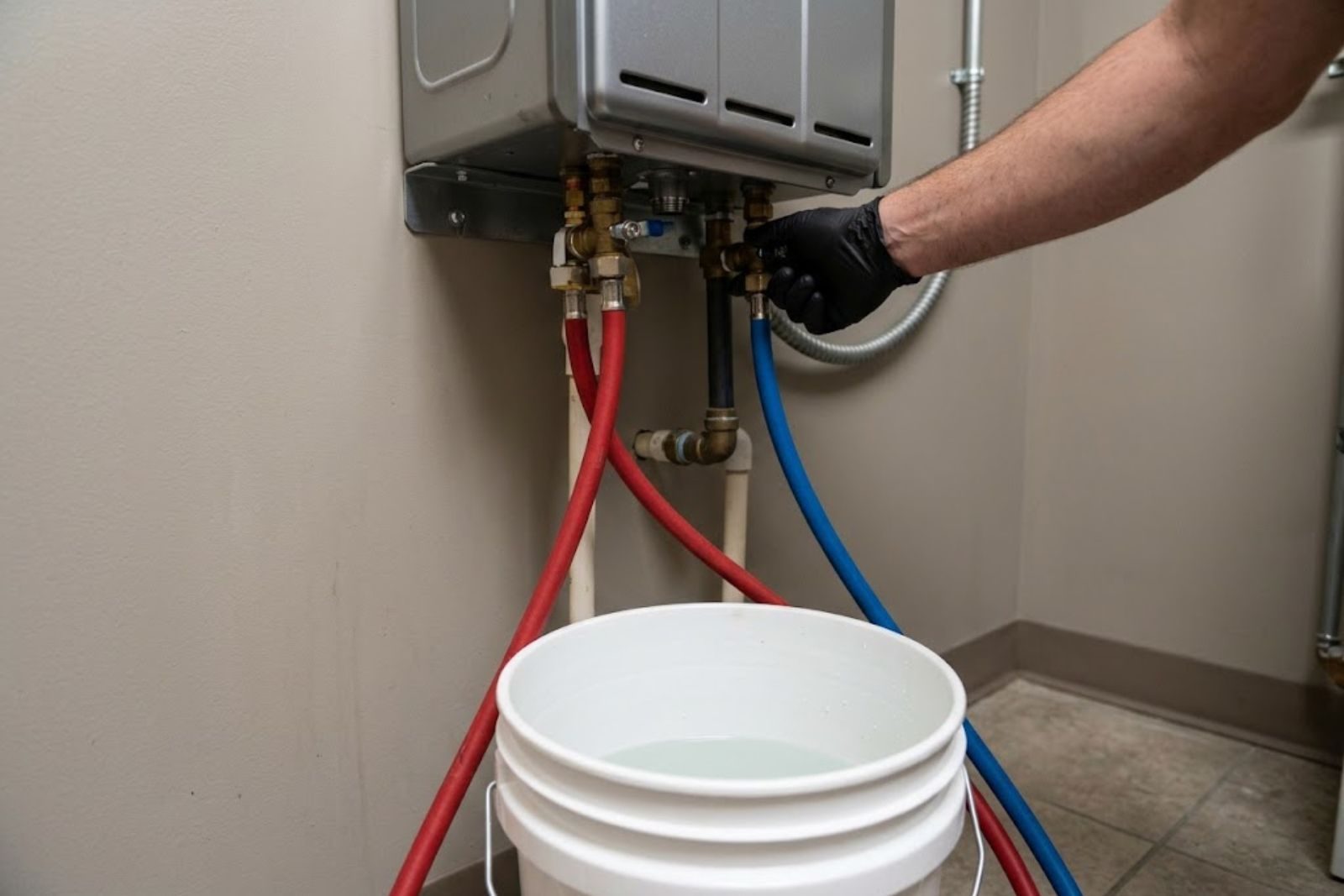
If you've switched to a tankless water heater, or you're considering one, there's a maintenance step that matters more in Walnut, CA than it might in a soft water region: periodic descaling. Skipping it doesn't cause immediate failure, but it steadily reduces efficiency and can shorten a unit's realistic service life well below its rated potential.
Why Tankless Units Are More Sensitive to Hardness Than Tank Units
A traditional tank water heater stores a large volume of water and deals with sediment settling at the bottom of that tank over time, a slow, gradual process. A tankless unit works differently: it heats water on demand as it passes through a compact heat exchanger with much tighter internal tolerances than a tank's large storage volume. That heat exchanger surface is exactly where mineral scale accumulates fastest, since it's the hottest surface the water contacts and heat accelerates mineral precipitation.
Walnut Valley Water District's Annual Water Quality Report classifies local water as moderately hard, and that mineral content builds up on a tankless unit's heat exchanger surface at a rate that meaningfully affects both heating efficiency and water flow rate if left unaddressed. This is exactly why tankless manufacturers are specific about recommending regular descaling in moderately hard water areas, rather than treating it as an optional maintenance suggestion.
What Happens Without Regular Descaling
Scale buildup on a tankless heat exchanger causes a few specific, cumulative problems. Reduced heating efficiency comes first, showing up as either slightly cooler water temperature than expected or the unit working harder (and using more energy) to hit the same target temperature. Reduced flow rate follows as scale narrows the effective internal diameter of the heat exchanger passages. In more severe cases, restricted flow and heat transfer can trigger error codes or cause the unit to shut down protectively rather than operate outside its designed parameters.
None of these failures happen overnight; they develop gradually as scale accumulates, which is part of why the problem is easy to overlook until it's noticeably affecting performance, rather than prompting an obvious dramatic failure that would make the cause immediately clear.
How Descaling Actually Works
Descaling a tankless water heater involves circulating a descaling solution, typically a food-grade acidic solution designed specifically for this purpose, through the unit's heat exchanger using a pump connected to the unit's isolation valves. The solution dissolves accumulated mineral scale, and after circulating for the manufacturer-recommended duration, the system is flushed clean with fresh water. Most units are designed with isolation valves specifically to make this process straightforward without needing to disconnect the unit from its plumbing and gas or electrical connections.
How Often Should You Descale?
Most tankless manufacturers recommend annual descaling specifically for moderately hard to hard water areas, which includes Walnut and the broader San Gabriel Valley communities we serve. This is more frequent than manufacturers recommend for genuinely soft water areas, where descaling every two to three years may be adequate, underscoring that this isn't a one-size-fits-all maintenance interval; it depends specifically on your local water hardness.
Signs Your Unit Is Overdue
- Water temperature that fluctuates or runs slightly cooler than it used to at the same setting
- Reduced flow rate, particularly noticeable when multiple fixtures draw hot water simultaneously
- Error codes related to flow restriction or overheating protection
- Audible changes in operation, sometimes described as a whining or straining sound during operation
- It's simply been more than a year since the unit's last descaling service, or you're not sure when it was last done
Does Warranty Coverage Depend on This?
Often, yes. Many tankless manufacturer warranties include maintenance requirements, including periodic descaling in hard water areas, as a condition of maintaining full warranty coverage. If a component fails and the manufacturer determines inadequate maintenance contributed to that failure, warranty coverage can be reduced or denied. Keeping documentation of when descaling service was performed protects your ability to make a warranty claim if a covered component does eventually fail, which is a practical reason to keep service records beyond simply wanting the unit to perform well.
Is This Different From What a Tank Water Heater Needs?
Yes, meaningfully. A tank water heater benefits from periodic tank flushing, draining a portion of accumulated sediment from the tank bottom, but the consequences of skipping this maintenance develop more slowly given the tank's larger water volume and less tightly-toleranced components. A tankless unit's more compact, precise internal components make it noticeably more sensitive to the same underlying hard water issue, which is why the maintenance recommendation is both more specific and more frequent for tankless units in areas like this one.
Should You Install a Water Softener Instead of Just Descaling?
These aren't mutually exclusive, and it's worth understanding them as different levels of response to the same underlying issue. Descaling addresses accumulated buildup after it's occurred; a whole-home water softener addresses the mineral content before it ever reaches the tankless unit (or any other fixture in your home) in the first place. A softener is a larger upfront investment but reduces or eliminates the ongoing need for tankless descaling, along with providing the same benefit to every other water-heating appliance and fixture in your home. Whether that broader investment makes sense depends on your specific household's priorities, how many water-heating appliances you're trying to protect, and how you weigh a larger upfront cost against smaller ongoing maintenance.
What This Means If You're Considering Switching to Tankless
If you're weighing a switch from a tank to a tankless water heater, factor the ongoing descaling requirement into your decision, not just the unit's upfront cost and space savings. It's not a dealbreaker, tankless units remain a solid choice in moderately hard water areas, but it is a real, recurring maintenance commitment that a tank unit doesn't require to the same degree, and going in with that expectation set correctly avoids surprise later when the manufacturer's warranty terms or a service technician mentions it for the first time.
What a Professional Descaling Visit Typically Includes
Beyond just running descaling solution through the unit, a thorough service visit usually includes checking the unit's inlet water filter, a small screen that catches sediment before it reaches the heat exchanger and can itself become clogged over time. It's also a reasonable opportunity to inspect venting for gas-fired units, confirm the unit's error log for any codes that haven't triggered an obvious symptom yet, and verify gas or electrical connections remain secure. Treating a descaling visit as a broader maintenance check, rather than narrowly just the descaling procedure itself, catches smaller issues before they become larger ones.
Can You Descale a Tankless Unit Yourself?
Technically, yes, with a descaling pump kit and the manufacturer-specified solution, and some homeowners do this themselves to save on service costs. That said, it requires correctly identifying and using the unit's isolation valves, following the manufacturer's specific procedure and duration, and safely handling the descaling solution itself. For a first-time DIY attempt, reviewing your specific unit's manual carefully, or having a professional walk through the process once before attempting it solo, reduces the risk of an incomplete flush or a mistake that could affect the unit's connections.
A Note for Commercial and Multi-Unit Properties
Properties with multiple tankless units, a commercial building or multi-family property with several units serving different areas, benefit from a scheduled, tracked maintenance program rather than relying on individual complaints to signal when service is needed. By the time a tenant or occupant notices reduced hot water performance, scale buildup has typically already progressed significantly. A proactive annual schedule across all units, tracked and documented, catches the issue before it affects anyone's day-to-day experience with the hot water system.