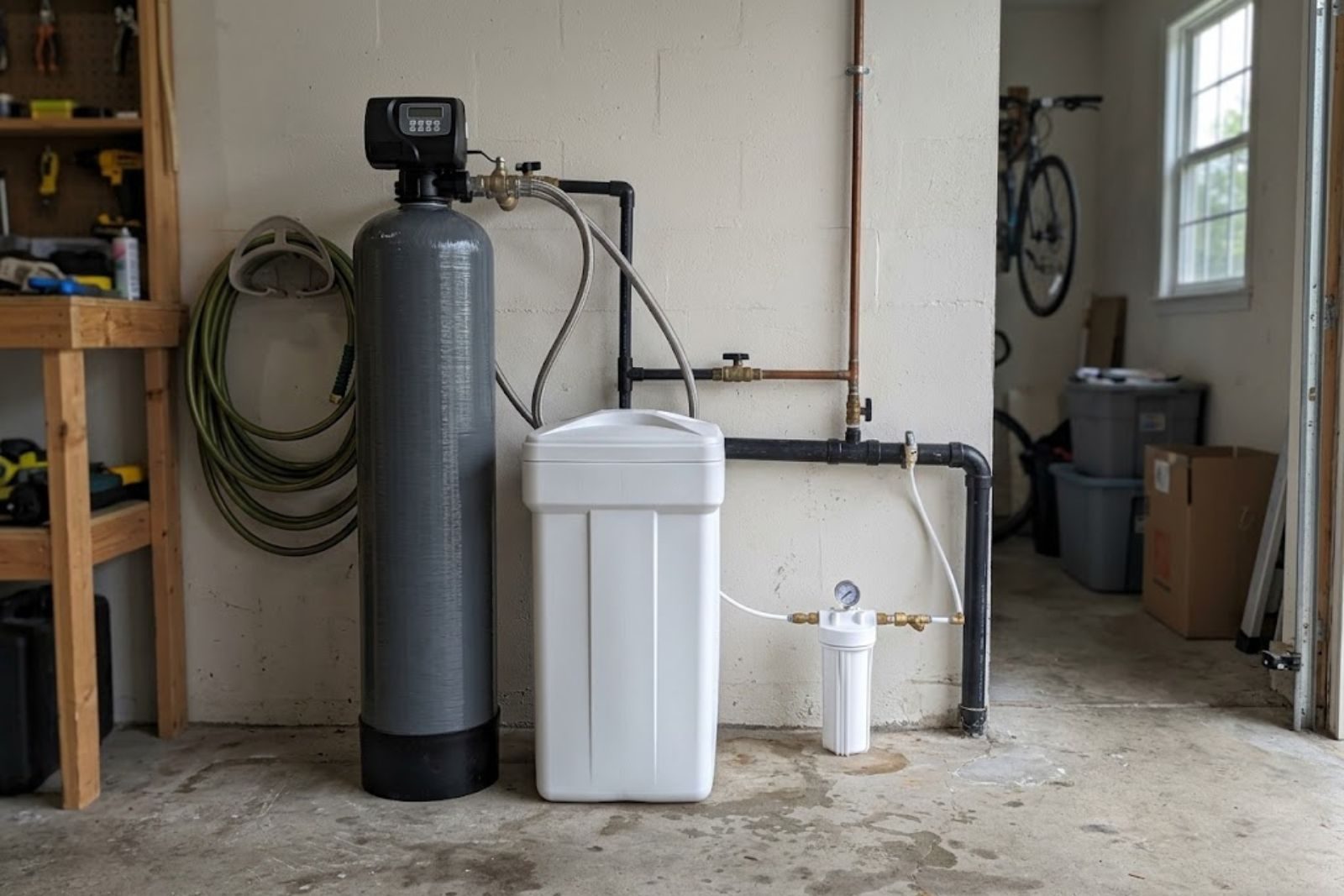
One of the most common points of confusion we run into with Walnut, CA homeowners is the difference between water softening and water filtration. They're often mentioned in the same breath, sometimes even used interchangeably in casual conversation, but they solve genuinely different problems, and understanding which one, or both, actually applies to your situation makes a real difference in what you end up installing.
What a Water Softener Actually Does
A water softener addresses one specific issue: hardness minerals, primarily calcium and magnesium, dissolved in your water supply. Walnut Valley Water District's Annual Water Quality Report classifies local water as moderately hard, and a softener removes those minerals through an ion-exchange process, swapping calcium and magnesium ions for sodium or potassium ions before water reaches your fixtures.
What softening solves: scale buildup on faucets and showerheads, reduced soap and detergent effectiveness, spotty dishes and glassware, and accelerated wear on water-heating appliances caused by mineral scale accumulating inside water heaters and dishwashers over time. What softening does NOT solve: taste, odor, chlorine smell, sediment, or any other water quality characteristic unrelated to hardness minerals specifically.
What Water Filtration Actually Does
Filtration is a broader category that addresses taste, odor, sediment, and specific compounds depending on the filter media used. Common reasons households choose filtration include a chlorine taste or smell left over from municipal water treatment, visible sediment or particulate in tap water, or wanting to reduce specific compounds beyond what hardness minerals represent.
Filtration doesn't address hardness minerals at all. A whole-home carbon filtration system, for example, is excellent at reducing chlorine taste and odor, but it does nothing to remove calcium and magnesium, meaning a household dealing with both hard water symptoms and chlorine taste complaints would need both systems addressed, not just one, to solve both problems.
Is Walnut's Water Actually Safe to Drink?
Yes. Walnut Valley Water District's Annual Water Quality Report confirms local water meets all state and federal drinking water safety standards. This is an important distinction to make clearly: neither softening nor filtration is correcting a safety problem with local tap water. Both are about taste, quality, and personal preference, addressing real, noticeable characteristics of the water, not fixing something unsafe. Any recommendation that implies otherwise, that your tap water is somehow dangerous without treatment, isn't accurate and shouldn't be the basis for a decision either way.
How to Decide What You Actually Need
Rather than defaulting to the most comprehensive (and expensive) system, it's worth matching the solution to your actual symptoms:
If you're seeing scale buildup, spotty dishes, or your water heater seems to be wearing out faster than expected: that's a hardness problem, and a softener is the appropriate solution.
If your water tastes or smells like chlorine, or you notice sediment: that's a filtration issue, and a whole-home or under-sink filtration system addresses it depending on whether you want the improvement at every fixture or just at your kitchen tap for drinking and cooking.
If you're dealing with both hardness symptoms and taste or odor complaints: both systems can be installed together, typically with the softener positioned first in the water line so filtration handles taste and quality on water that's already had hardness minerals addressed.
Whole-Home vs. Under-Sink Filtration
For filtration specifically, there's a further decision between whole-home and under-sink systems. A whole-home system filters water at the point it enters your house, improving water quality at every fixture including showers, which some households value for skin and hair concerns related to chlorine exposure during bathing, not just drinking water taste. An under-sink system targets just your drinking and cooking water at a specific fixture, typically the kitchen sink, at a lower upfront cost but requiring more frequent filter cartridge changes given the more concentrated flow through a smaller unit.
What Maintenance Each System Actually Requires
A salt-based softener needs periodic salt refills, typically every few weeks to a couple of months depending on household water use, plus occasional resin bed service every several years. A salt-free water conditioner, which alters mineral behavior rather than removing minerals entirely, generally requires less ongoing maintenance but works somewhat differently and is worth understanding before choosing between the two softening approaches.
Filtration systems need periodic cartridge replacement, with the frequency depending on the specific system and your household's water use. Under-sink cartridges typically need changing every 6-12 months; whole-home system media varies more widely depending on what's being filtered and the media type used.
A Reasonable Way to Approach This Decision
Rather than researching every possible system configuration on your own, it's often more efficient to describe your specific symptoms directly, scale buildup, taste complaints, sediment, spotty dishes, whatever's actually bothering you, and let that guide the recommendation rather than starting from "I need a water treatment system" and working backward. The right system, or combination of systems, follows naturally from the actual problem you're trying to solve, and it's a much more useful starting point than trying to select from a catalog of options without a clear sense of which specific issue each one addresses.
Why the Terminology Gets Confused
Part of the confusion here comes from marketing language that isn't always precise or consistent across brands and retailers. "Water conditioning" sometimes refers specifically to salt-free softening, sometimes to a broader category that includes filtration, and "purification" gets used loosely to describe everything from basic sediment filtration to reverse-osmosis systems that remove a much wider range of dissolved substances. If you're comparing quotes or researching options and see these terms used inconsistently between different sources, that's a sign to ask specifically what the system actually removes and how it works, rather than relying on the category label alone to tell you what you're getting.
What a Combined System Actually Looks Like
For households that want both hardness and taste/quality addressed, a combined installation typically places the softener first in the water line, treating hardness before the water reaches a filtration stage. This sequencing matters because filtration media, especially carbon-based media common in whole-home filtration, works more effectively and lasts longer when it isn't also dealing with mineral scale accumulating on its surface. Softening first, then filtering, generally outperforms either the reverse order or trying to combine both functions into a single unit not designed for combined treatment.
Cost Considerations Between the Two
Softeners and filtration systems occupy different price ranges depending on scope and system type, and it's worth thinking about them as separate line items with separate justifications rather than a single combined decision. A softener's cost is driven primarily by system capacity, sized to your household's water use and hardness level. Filtration cost varies more by scope, whole-home versus under-sink, and by the specific media required for whatever you're trying to filter out. Buying more capability than your actual symptoms justify, a large whole-home filtration system when your only complaint is chlorine taste at the kitchen tap, for example, means paying for capacity you're not actually using, which is exactly why starting from your specific symptoms rather than the most comprehensive available system leads to a more cost-effective outcome for most households in the long run.